Quote: stone façade repointing
E.g.: repointing a natural stone facade with lime mortar
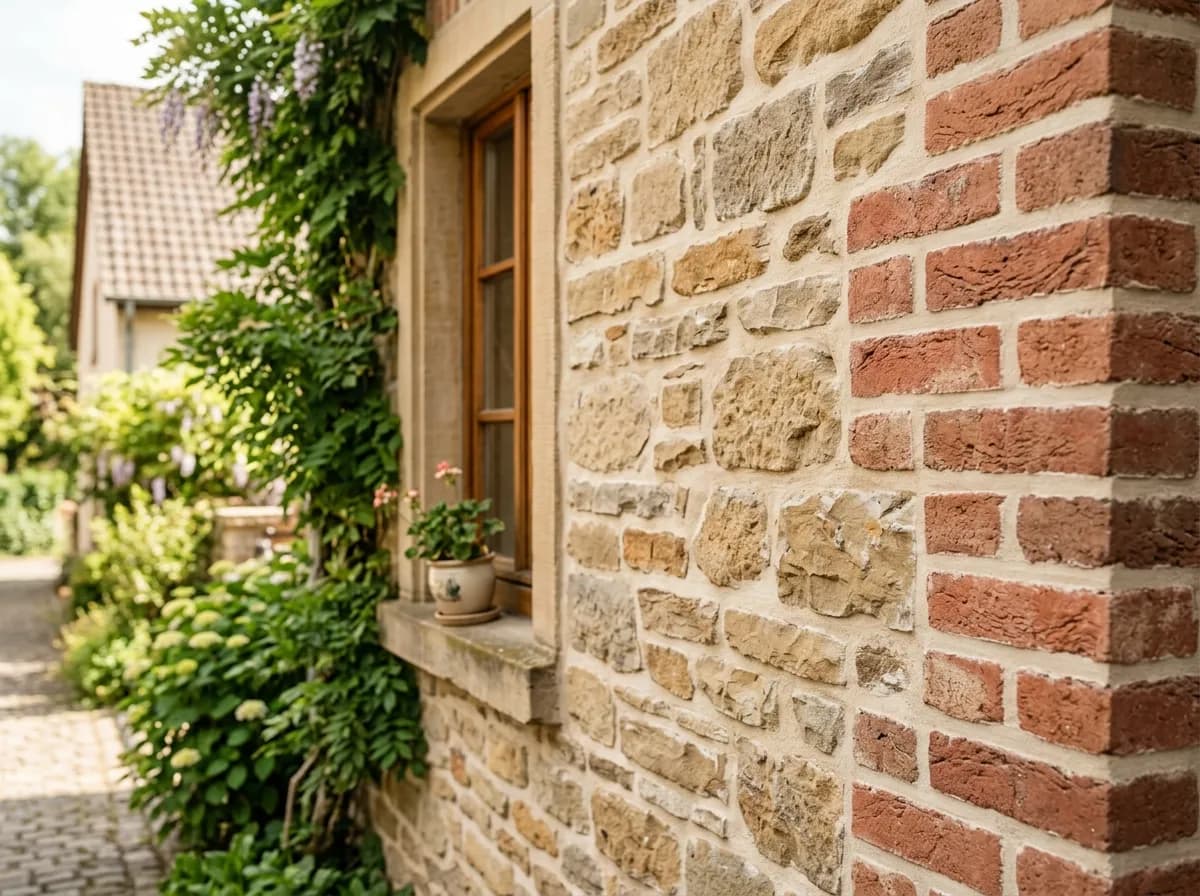
Repointing does not necessarily mean the entire façade. Have joints, stone and earlier repairs assessed to decide what can remain. Mention heritage status and damp marks before selecting mortar and joint appearance.
Assess stone as well as joints
INPA recommends diagnosis and stone conservation. Distinguish patina, damaged joints and material deterioration. Do not strip old surfaces merely to make them look new.
Define removal
Map retained and renewed joints with a trial suited to stone and old mortar. Clarify edge protection. One depth or tool is not automatically suitable for every stone arrangement.
Justify mortar
Request composition, compatibility with stone and retained joints, colour and texture. Do not select the hardest mortar or a lime grade from building age alone. Clarify analysis needed for unknown materials or earlier repairs.
Approve a trial area
Buildwise highlights joint colour and type at handover. Agree a dry sample for profile, recess and texture. Define accepted old/new differences without promising perfect uniformity.
Separate other defects
Leaking pipes, defective sills or wall movement may not be resolved by new joints. Identify tasks and sequence. Check whether cleaning is needed and how stone is protected; water repellent is not an automatic finish.
Check protection and grants beforehand
Consult heritage bodies before work on protected buildings. INPA provides conditional restoration applications before work. Do not assume either guaranteed support or exclusion because only joints are repaired.
Indicative prices in Luxembourg
On quotation
Cost depends on scope, access and removal without damaging stone. Separate stone replacement, repairs, cleaning and new joints. A small heavily damaged area cannot be compared with a whole façade without quantities.
Subsidies and grants
No grant is deducted from the budget shown here. If a quote mentions support, request the exact scheme and confirmation of your eligibility before including it in financing.
Frequently asked questions
Is a recessed joint necessarily damaged?
No. It may be the original profile. Assess condition first.
Must every joint be renewed?
Assessment should justify retained and renewed areas.
Is the hardest mortar preferable?
Compatibility with stone and the wall determines choice.
Does repointing repair the structure?
Not automatically. Stability requires separate assessment.
Could the building receive support?
Check protection, work and INPA procedures before starting.